Motivation
Mechanistic models of process systems are often incomplete: a reaction rate, a growth term or a transfer coefficient depends on the states in a way nobody has written down. A hybrid model keeps the known balances and learns the missing term from data, so it stays physically consistent where the data run out. Open-source tools for this mostly target ODEs and train by integrating and backpropagating; few handle differential-algebraic systems, where algebraic constraints must hold exactly alongside the dynamics.
Method
The network enters the model as one more algebraic equation, and the whole system is discretised by Lagrange–Radau collocation:
The weights and the trajectories are then solved for together, so the constraints hold at every collocation point by construction, index-2 systems included. The decomposition backend instead updates the weights in an outer Adam loop around per-trajectory solves, with gradients from the KKT system, and spreads across trajectories with MPI.
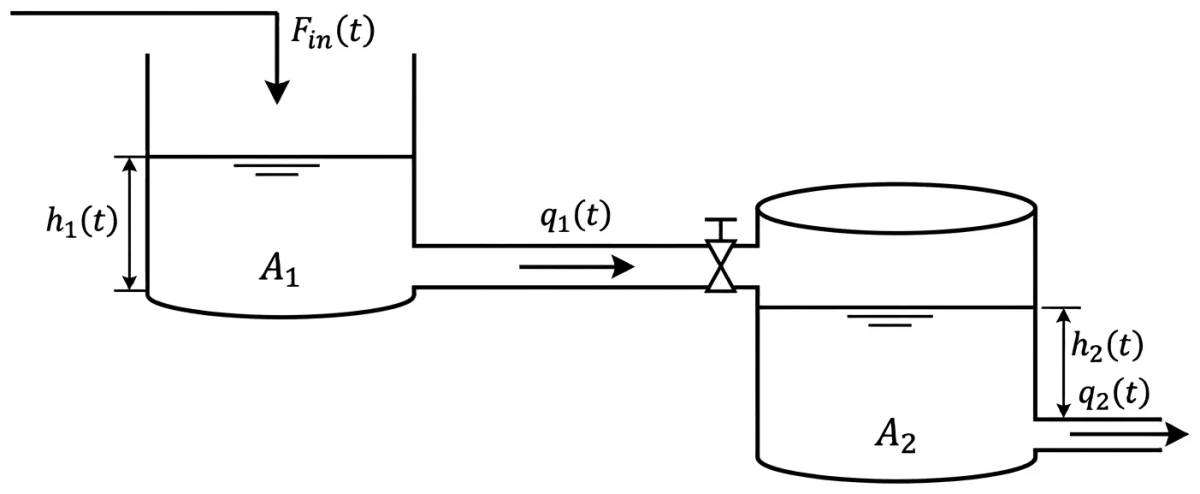
Two-tank example
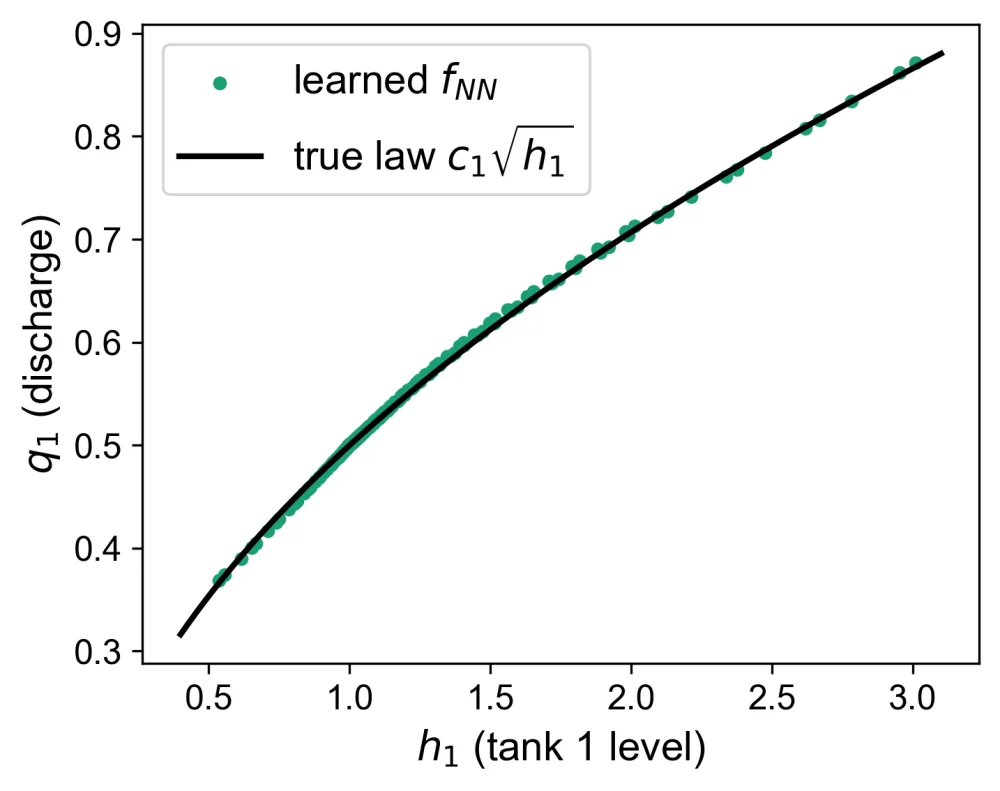
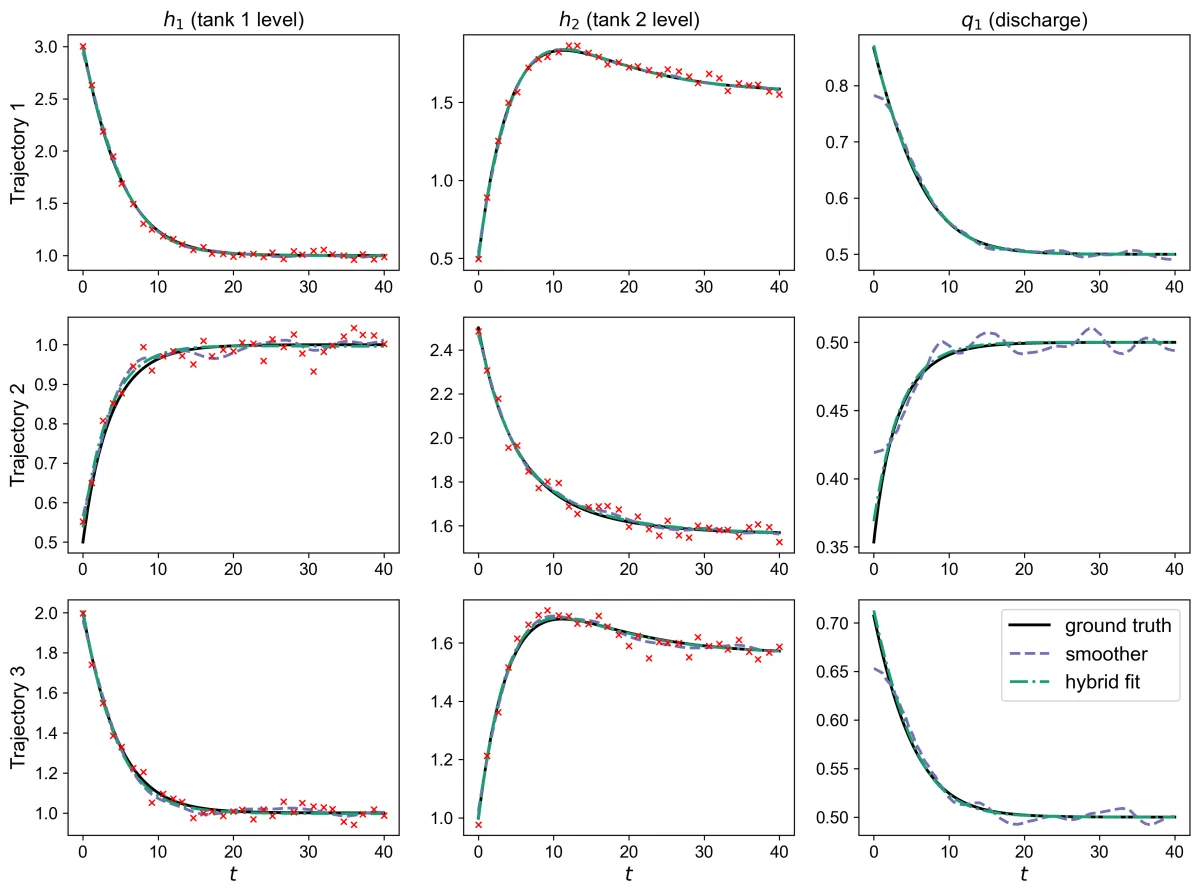
Two tanks in series under a constant feed, the system in the figure at the top of the page. The outlet valve law of the second tank is known; the discharge between the tanks is not, and is learned from noisy level measurements alone. The network is given no structure, yet its response falls onto the true law, and predictions from unseen initial levels track the reference.
Package
A scikit-learn-style HybridDAE runs smoothing, pre-training, training and prediction behind fit and predict. The default install is pure pip wheels, with the POUNCE and FERAL solvers replacing licensed HSL binaries, and trained networks export to ONNX, Equinox, OMLT and JSON. A sindae-skills bundle lets Claude Code draft and check a hybrid model with the user before any code runs.
Further reading
 SiNDAE: the simultaneous neural DAE training Python packageJournal of Open Source Software, first author, submittedPreview PDF
 A simultaneous approach for training neural differential-algebraic systems of equationsLueg, Alves, Schicksnus, Kitchin, Laird, Biegler. The method SiNDAE implements.Open ↗
 Software Tools and Implementations for Process Systems EngineeringAIChE Annual Meeting 2026, session 542, Minneapolis. SiNDAE was shown here.Open ↗